
Property repair coordination is the process of managing contractor relationships, scheduling maintenance work, and overseeing communication between tenants, owners, and tradespeople to protect property value and keep occupants satisfied. For estate agents, this process, known formally as maintenance management, sits at the heart of every successful lettings or sales operation. Done well, it prevents costly delays, reduces tenant complaints, and gives landlord clients the confidence that their assets are in safe hands. This guide covers the tools, workflows, and vendor strategies that make estate agent repair coordination reliable, transparent, and efficient.
How to coordinate property repairs as an estate agent
Effective repair coordination starts before a single job is raised. The foundation is a vetted contractor network, a clear work order system, and agreed communication protocols with every party involved.

Building your contractor network
Reliable local contractors are the single most important asset in any repair coordination setup. Before adding a tradesperson to your approved list, verify their public liability insurance, relevant trade licences, and average response time. Ask for references from other agents or landlords, not just homeowners. A contractor who is brilliant with private clients but unreachable during a tenant emergency is a liability, not an asset.
- Confirm public liability insurance of at least £1 million
- Check Gas Safe, NICEIC, or relevant trade registration where applicable
- Agree a standard response window: 24 hours for urgent work, 5 working days for routine repairs
- Set pricing parameters in advance to avoid invoice surprises
Choosing a digital maintenance management system
Property managers handling 50+ units spend 22 hours weekly coordinating repairs manually. Switching to a digital computerised maintenance management system (CMMS) reduces costs by £95,000 to £140,000 annually. That figure reflects the hours saved on phone calls, chasing invoices, and re-scheduling missed appointments.
Platforms such as OxMaint and QuoteIQ centralise work orders, contractor communication, and repair histories in one place. Integrated property maintenance platforms replace multiple apps for a fraction of the cost and can facilitate same-day service for many repairs. For estate agents managing multiple landlord portfolios, this consolidation is not a luxury. It is the difference between a reactive and a proactive service.
Pro Tip: Set up a shared digital folder for each property containing boiler service records, electrical inspection certificates, and contractor contact details. This cuts diagnostic time on every new repair request.
Before going live with any system, prepare a short preparation checklist:
- Document all properties with photos, floor plans, and utility locations
- Create scheduling templates for routine inspections and seasonal maintenance
- Agree pricing parameters with contractors for common repair types
- Set up a dedicated communication channel for each landlord client
How do estate agents manage and prioritise repair requests?
Repair intake is where most coordination problems begin. Without a structured triage process, urgent jobs get lost alongside routine ones, and tenants feel ignored.
The most reliable intake method is a tenant portal or dedicated reporting app where occupants can submit a description, photos, and their availability. Allowing tenants to submit repair photos can halve diagnostic delays, because contractors arrive with the right parts and a clear picture of the problem. This single change removes the most common source of wasted call-outs.
Once a request is received, triage it using a simple three-tier system:
- Emergency: Risk to safety or structural integrity. Examples include gas leaks, total boiler failure in winter, or a burst pipe. Target response: within 4 hours.
- Urgent: Significant inconvenience but no immediate safety risk. Examples include a broken lock, no hot water, or a faulty oven. Target response: within 24 hours.
- Routine: Minor repairs with no impact on habitability. Examples include a dripping tap, a stiff door hinge, or a cracked tile. Target response: within 5 working days.
AI-integrated maintenance systems auto-score request urgency and automatically loop in the appropriate vendor, which allows estate agents to focus on portfolio strategy rather than administrative triage. For agents managing more than 20 properties, this automation pays for itself quickly.
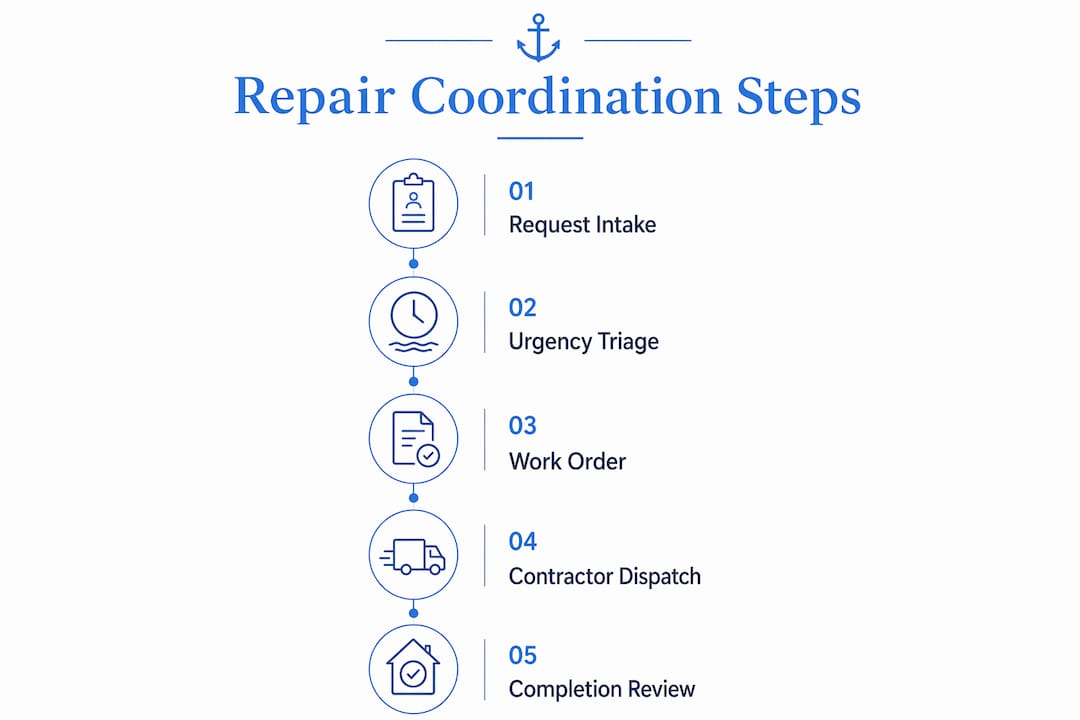
Once categorised, raise a formal work order with the job description, property address, tenant contact details, and agreed pricing parameters. Send this to the contractor digitally so there is a written record from the outset.
Pro Tip: Create a standard message template for tenants confirming receipt of their repair request, the urgency category assigned, and the expected response window. This one step reduces follow-up calls by a significant margin.
What are best practices for coordinating multiple vendors?
Managing several contractors across a portfolio requires a single source of truth. Fragmented scheduling, where one agent emails a plumber, another calls an electrician, and a third texts a handyman, creates gaps, duplicated work, and missed updates.
Estate agents using single-point contractor dispatch and comprehensive reporting reduce repair coordination complexity significantly. The practical application is straightforward: assign one team member or one platform as the sole point of contact for all contractor communication on a given property.
Tracking progress and quality
Every completed job should be documented with at least one completion photograph and a signed-off work order. For Cornwall property maintenance or any regional portfolio, photo reports are particularly valuable for remote landlord clients who cannot inspect the work themselves. They provide proof of completion and protect the agent if a dispute arises later.
The table below outlines a practical vendor management framework:
| Stage | Action | Tool or method |
|---|---|---|
| Job raised | Issue digital work order | CMMS platform or email template |
| In progress | Contractor updates status in real time | Tenant portal or messaging app |
| Completed | Contractor submits completion photo | Platform upload or WhatsApp |
| Invoiced | Agent reviews against agreed pricing | Spreadsheet or CMMS invoice module |
| Quality check | Agent or tenant confirms satisfaction | Follow-up message or call |
Handling disputes and rework
When a repair falls short, act quickly. Contact the contractor within 24 hours of the complaint, share the tenant's feedback and any photos, and agree a return visit date in writing. Most reputable tradespeople will return without charge if the issue is clearly within the scope of the original job. If a contractor refuses or repeatedly delivers poor workmanship, remove them from your approved list. Protecting your landlord clients means holding vendors to a consistent standard.
How can repair coordination improve sales and lettings transactions?
Repair coordination is not only a property management tool. It is a direct lever on transaction speed and negotiation outcomes.
In sales, the period between offer acceptance and exchange is where repair-related delays most often derail deals. Buyers commission surveys, surveyors flag defects, and sellers scramble to find contractors at short notice. Obtaining line-item contractor quotes pre-closing smooths negotiation and avoids transaction delays by giving both parties clear, costed information rather than vague estimates.
Follow these steps to use repair coordination as a sales tool:
- Commission a pre-market condition report to identify likely survey findings before the property is listed.
- Obtain written, line-item quotes from vetted contractors for every flagged item.
- Share the quotes with the vendor so they can decide whether to repair or adjust the asking price accordingly.
- If repairs are agreed, schedule and complete them before the buyer's survey where possible.
- For post-survey repairs, use pay-at-closing services that engage contractors without requiring upfront payment from the vendor. This prevents sales from falling through when vendors lack immediate funds for repairs.
In lettings, the priority shifts to minimising void periods. A property that sits empty for two weeks between tenancies because a contractor was unavailable costs the landlord real money. Pre-agreed contractor relationships and a standing work order template mean that end-of-tenancy repairs begin within 48 hours of the outgoing tenant leaving. Most small repairs complete within 5 business days with options for same-day service on urgent work, which makes tight turnaround targets achievable when the right network is already in place.
What common challenges arise in repair coordination and how to overcome them?
The most persistent problem in property repairs coordination is the spreadsheet and email trap. Many agents manage repairs through a combination of inbox folders, phone calls, and shared spreadsheets. This works until it does not. A missed email, a full voicemail, or a contractor who changes their number creates a gap that costs time and damages client trust.
The solution is an integrated platform that logs every request, every update, and every invoice in one place. Bilateral communication platforms enabling direct tenant-to-vendor messaging reduce middleman delays significantly. When a tenant can message a plumber directly through a managed portal, the agent remains in the loop without becoming the bottleneck.
Other common challenges and their practical solutions:
- Vendor no-shows: Confirm every appointment by message the evening before. If a contractor cancels, have a second-tier backup contractor for each trade on your approved list.
- Unclear invoicing: Agree pricing parameters before work begins and require itemised invoices. Vague invoices create disputes and slow payment, which damages contractor relationships.
- Tenant miscommunication: Send written confirmation of every repair appointment, including the contractor's name and the expected arrival window. Tenants who feel informed rarely escalate complaints.
- Emergency gaps: Identify at least one contractor per trade who offers out-of-hours cover. For urgent holiday let repairs, a rapid-response local service is worth the premium.
"The agents who manage repairs best are not the ones with the most contractors on their list. They are the ones with the clearest processes and the most consistent communication."
Key takeaways
Effective estate agent repair coordination depends on three things: a vetted local contractor network, a digital management system, and clear communication protocols with every party involved.
| Point | Details |
|---|---|
| Build a vetted contractor network | Verify insurance, trade registration, and response times before adding any tradesperson to your approved list. |
| Adopt a digital CMMS | Platforms like OxMaint and QuoteIQ centralise work orders and cut coordination time significantly. |
| Triage every repair request | Categorise jobs as emergency, urgent, or routine and issue a formal work order for each. |
| Use repair coordination in transactions | Pre-market quotes and pay-at-closing services prevent survey findings from derailing sales. |
| Document every completed job | Completion photos and signed work orders protect agents and give remote landlords confidence. |
What I have learned from years of repair coordination
The conventional wisdom is that more contractors means more coverage. In practice, the opposite is true. A long list of tradespeople with no established relationship is almost useless in an emergency. The agents I have seen manage repairs most effectively work with a small, trusted group of local contractors who know their properties, understand their standards, and pick up the phone.
Digital tools matter, but they are only as good as the process behind them. I have watched agents adopt expensive platforms and still coordinate repairs by phone because they never built the workflow to support the technology. The platform is not the solution. The process is the solution, and the platform makes it faster.
The area where most agents leave value on the table is pre-sale coordination. Getting line-item quotes before a property goes to market, and sharing them openly with buyers, removes the fear and uncertainty that kills deals at the survey stage. Post-inspection repairs with vetted contractors prior to closing create transparency and smoother deals. Buyers trust agents who present problems with solutions already attached.
Finally, repair coordination directly affects portfolio value. A landlord whose properties are well maintained, whose tenants feel heard, and whose repairs are completed on time will stay with an agent for years. That retention is worth far more than any individual commission.
— Love
How Coastandquay supports estate agents with property repairs
Estate agents working across Cornwall can rely on Coastandquay for trusted, local property maintenance management that takes the coordination burden off their desk.

Coastandquay offers property maintenance plans designed specifically for landlords and estate agents, covering routine upkeep, urgent repairs, and photo reports for remote owners. Every job is handled by a reliable local contractor with quality workmanship guaranteed. Fast quotes, transparent pricing, and clear communication mean your landlord clients stay informed without you chasing updates. For agents who need Cornwall property care they can depend on, Coastandquay is the local partner built for the job.
FAQ
What does it mean to coordinate property repairs as an estate agent?
Property repair coordination means managing the full process of raising, scheduling, and completing maintenance work across a portfolio. It includes vetting contractors, triaging tenant requests, issuing work orders, and reporting outcomes to landlord clients.
How can digital tools improve repair coordination?
Platforms such as OxMaint and QuoteIQ centralise work orders, contractor updates, and invoicing in one place. Switching to a digital CMMS can reduce coordination costs by £95,000 to £140,000 annually for agents managing large portfolios.
How should estate agents prioritise repair requests?
Triage repairs into three categories: emergency (respond within 4 hours), urgent (within 24 hours), and routine (within 5 working days). Assign a formal work order to each category and dispatch the appropriate contractor immediately.
How does repair coordination help during property sales?
Obtaining line-item quotes before listing and coordinating post-survey repairs with vetted contractors prevents delays at exchange. Pay-at-closing services allow vendors to authorise repairs without upfront funds, keeping transactions on track.
What is the most common mistake in property repair coordination?
Relying on spreadsheets and email chains without a centralised system is the most common failure point. A single missed message can delay a repair, frustrate a tenant, and damage a landlord client relationship.